Climate change and environmental degradation have become one of the greatest challenges confronting humanity today. Governments across the world are investing billions of Rupees to reduce greenhouse gas emissions from the energy, industry and transportation sectors. Yet one of the most powerful drivers of climate change often escapes adequate attention and that is – our food system.
Over the past few decades, global meat production and consumption have increased dramatically. To meet this growing demand, livestock farming and the meat industry have expanded on an unprecedented scale, contributing to deforestation, excessive water consumption, land degradation, air and water pollution, and greenhouse gas emissions. Scientific studies identify the livestock sector as a significant contributor to climate change. Methane and nitrous oxide, released in large quantities through livestock production, have a much greater warming effect than carbon dioxide.
Interestingly, most of the meat consumed globally comes from the animals that themselves consume plant-based feed. Common livestock like cattle, sheep, and goats are strict herbivores while poultry farms also predominantly on cereal and soy-based feed. Consequently, the environmental footprint of meat extends well beyond livestock itself. It begins with the cultivation of feed crops, continues through livestock rearing, transportation, processing, refrigeration, and distribution, and finally reaches the consumer’s plate. Research indicates that a substantial share of emissions associated with livestock comes from feed production and enteric fermentation in animals, making meat production one of the most resource-intensive food systems in the world.
A striking fact often overlooked is that nearly 40 percent of the world’s grain production is used as animal feed rather than being consumed directly by humans. In some developed countries, this proportion reaches almost 70 percent. As global population and food demand continue to rise, the efficient use of food grains will become increasingly important.
Research shows that producing one kilogram of beef typically requires more than 15,000 litres of water, whereas cereals and pulses generally require less than 1,500 litres. Similarly, meat production requires significantly more land and energy than plant-based foods. In an age of growing water scarcity and shrinking natural resources, these differences deserve serious attention.
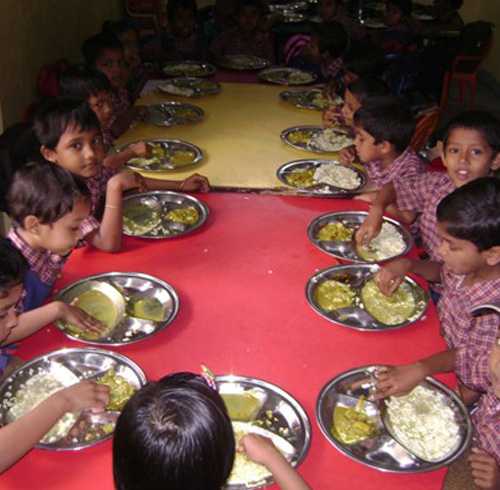
In this context, Bharat’s experience offers an important lesson to the world. Bharat remains one of the few major countries where a large segment of the population still relies primarily on plant-based diets. Even among non-vegetarians, meat is often consumed occasionally rather than as a daily staple. This makes Bharat a unique case in the global food landscape.
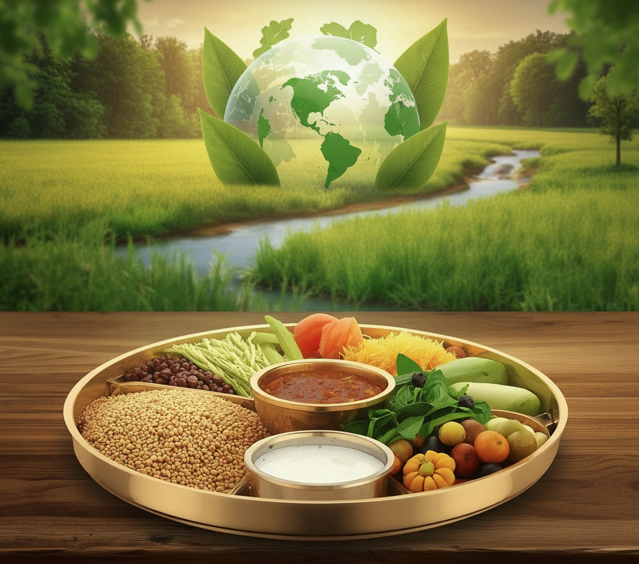
Bharat’s per capita carbon emissions are approximately 2.2 tonnes per year, less than half of the global average of 4.8 tonnes. In contrast, per capita emissions exceed 14 tonnes in the United States, around 15 tonnes in Russia, and about 10 tonnes in China. Several factors contribute to this difference, but Bharat’s traditional food culture is undoubtedly one of them. Bharatiya diets are rich in pulses, cereals, millets, fruits, vegetables, and dairy products. These foods are not only nutritionally balanced but also require substantially fewer natural resources than meat-based diets.
Bharat’s food culture is rooted in deeper civilizational values. Jain, Buddhist, and Vedic traditions have long nurtured the principles of Ahimsa, compassion, restraint, and respect for all forms of life. The civilizational ideal of Ahimsa encouraged a culture of restrained consumption, coexistence with nature, and respect for all living beings, the timeless principles that modern sustainability discourse is only now beginning to rediscover.
However, this civilizational advantage is gradually being eroded. Globalization, urbanization and consumerism are rapidly transforming dietary preferences across the world, including in Bharat. Rising incomes and changing lifestyles have encouraged greater consumption of meat and highly processed foods. If this trend continues unchecked, it could place additional pressure on land, water, forests, and the climate.
The issue, however, is not about restricting individual freedom of choice. Every citizen has the right to decide what to eat. At the same time, food choices also have environmental consequences that affect society as a whole. Discussions on food systems should therefore move beyond political controversies and be guided by scientific evidence, public awareness, and environmental responsibility.
Achieving the United Nations Sustainable Development Goals and global climate commitments will require more than just decarbonizing the energy sector. Transformations in food production and consumption patterns will also be necessary. Promoting traditional Bharatiya foods, encouraging the cultivation of millets and pulses, reducing food waste, and supporting innovative plant-protein alternatives can significantly reduce environmental pressures while ensuring nutritional security. The United Nations has declared 2023 as the International Year of Millets, an initiative led by Bharat. Millets, pulses and traditional Bharatiya cereals are not only climate-resilient crops but also require significantly less water and chemical inputs than many modern agricultural systems.
Bharat has an important message to offer the world. It possesses a civilizational model of sustainable living that has evolved over thousands of years. The solution to climate change may not emerge only from advanced technologies and billion-dollar innovations. It may also come from timeless civilizational wisdom reflected in our everyday choices. If humanity is to build a sustainable future, the Bharatiya ideals of moderation, Ahimsa, and plant-based living may prove as valuable as any technological breakthrough. The future of the planet may depend not only on how we produce energy, but also on what we choose to put on our plates.
Dr Amit Jhalani,
Convener, Centre for Social and Cultural Studies Rajasthan